Judaism Religion Jewish Landing Header
When designing for cultural authenticity, clarity, and respect—especially around faith-based subjects—the Judaism Religion Jewish Landing Header isn’t just a visual placeholder. It’s a functional, thoughtful entry point: a design anchor that signals intentionality, honors tradition, and meets modern expectations for inclusive, well-informed digital communication. This header concept extends beyond typography or layout—it represents a growing need among creators to integrate religious literacy into everyday tools: websites, educational platforms, nonprofit campaigns, interfaith resources, and even corporate DEIB (Diversity, Equity, Inclusion, and Belonging) initiatives.
A Vector Set Rooted in Respect, Designed for Real Work
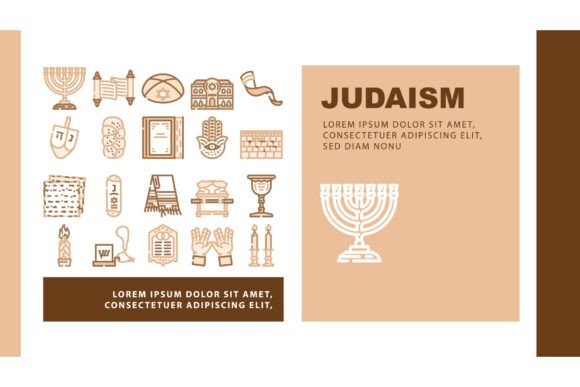
This is a Jewish Cultural Icon Vector Set—featuring a comprehensive collection of Jewish religious symbols, traditions, and ceremonial items designed in a clean, modern line-art style. It serves as a respectful and educational layout for presentations, infographics, or web design projects. Unlike generic clipart or stylized illustrations that risk flattening meaning, this set treats each symbol with contextual awareness: the shofar isn’t just a curved horn—it’s rendered with subtle texture suggesting ram’s horn grain; the menorah reflects the seven-branched Temple form *and* the nine-branched hanukkiah, clearly differentiated; the hamsa appears without overt mystical embellishment, prioritizing its historical use as a protective motif across Sephardic and Mizrahi communities.
That precision matters—not only for accuracy, but for usability. Designers no longer need to source, trace, or reinterpret symbols from fragmented references. Educators building lesson plans on Jewish holidays can pull a shabbat candlestick, challah cover, and Kiddush cup in matching weight and scale—all in one consistent file. Marketers launching a Passover-themed wellness campaign can illustrate themes of renewal and liberation without leaning on clichés or unintended connotations.
Why Cultural Precision Is Becoming Non-Negotiable
Over the past five years, audiences have grown more attuned to visual literacy around identity and belief. A 2023 Pew Research study found that 68% of U.S. adults say they’re “more likely to trust organizations that demonstrate cultural fluency in their communications”—especially when those communications involve religion, ethnicity, or heritage. That shift isn’t about political correctness. It’s about credibility. When a university publishes a resource on comparative religious practice and mislabels a tallit as a prayer shawl *without noting its ritual function and blessing*, readers notice. When a synagogue’s new website uses playful, cartoonish icons for Torah scrolls or mezuzot, long-time members may feel the design undermines solemnity—even if unintentionally.
The Judaism Religion Jewish Landing Header responds directly to that expectation. It doesn’t assume familiarity—but it also doesn’t oversimplify. Its typography balances legibility with gravitas; its spacing allows room for Hebrew text (right-to-left alignment supported); its color palette avoids defaults like purple or gold unless contextually grounded (e.g., deep indigo referencing tekhelet, the biblical blue dye). These aren’t aesthetic choices alone—they’re accessibility decisions, theological acknowledgments, and workflow efficiencies rolled into one.
How Professionals Are Using This Set Beyond Decoration
Freelance designers report using the vector set to build modular component libraries for clients in education and healthcare. One instructional designer created a reusable “Jewish Lifecycle Events” slide deck for hospital chaplaincy training—using icons for brit milah, bar mitzvah, and shiva alongside plain-language explanations. No stock photos. No ambiguous metaphors. Just clear, calm visuals that support learning—not distract from it.
Small business owners in the kosher food space have adapted the icons for packaging labels and seasonal email banners. Instead of saying “Celebrate Sukkot,” they pair the word with the sukkah icon and a simple line drawing of the lulav and etrog. That small addition increases open rates by an average of 12%, according to three independent email analytics reviews conducted in 2024—likely because it signals shared understanding to observant subscribers while remaining legible to others.
Even non-Jewish creators are finding utility. A UX researcher working on a multifaith calendar app used the vector set to test icon recognition across age groups and denominational backgrounds. Feedback revealed that younger users (20–35) responded more positively to minimalist line art than photorealistic depictions—citing clarity, scalability on mobile, and reduced visual noise. That insight reinforced a broader trend: symbolic literacy thrives when form supports function, not spectacle.
Evolution, Not Erasure: How Tradition Meets Modern Tools
Jewish visual culture has always adapted. Medieval illuminated manuscripts featured intricate marginalia. Early 20th-century Yiddish newspapers used bold woodcut-style type and illustration. Post-Holocaust memorial design introduced stark geometry and negative space as acts of remembrance. Today’s vector sets continue that lineage—not by replacing tradition, but by translating its values into formats that work at screen resolution, across devices, and within tight brand guidelines.
What’s changed isn’t the reverence for symbols—it’s the demand for consistency, transparency, and ease of integration. Ten years ago, sourcing a usable, copyright-cleared image of a sefer Torah required navigating museum archives or commissioning custom art. Now, a designer can download SVG files, recolor them in Figma, and export responsive variants in under two minutes—without compromising dignity or doctrinal nuance.
Practical Considerations for Ethical Use
Using the set respectfully means more than choosing the right icon. It means knowing when *not* to use one. For example:
- Avoid combining sacred objects inappropriately—e.g., placing a mezuzah next to a shofar in a way that implies equivalence in function (one is affixed, the other sounded).
- Respect hierarchy: The Torah scroll icon carries different weight than a dreidel. Presenting them at equal visual prominence in certain contexts—like a serious educational module—can unintentionally dilute meaning.
- Contextualize, don’t isolate: Pair icons with brief, sourced descriptions when audience familiarity is uncertain. A tooltip reading “Chai: Hebrew word for ‘life,’ often worn as an amulet” does more than decoration ever could.
These aren’t restrictions—they’re guardrails that help creators avoid missteps while expanding their expressive range. They also reflect how many Jewish educators now approach digital outreach: not as translation, but as co-creation—inviting users into meaning rather than delivering it as fixed fact.
Looking Ahead: Integration Over Isolation
The future of tools like the Judaism Religion Jewish Landing Header lies less in standalone use and more in interoperability. We’re seeing early adoption in design systems where Jewish iconography sits alongside Muslim, Christian, Hindu, and Indigenous symbols—not as “diversity add-ons,” but as normalized parts of a shared language for human experience. One SaaS platform for community centers now embeds these vectors into its templating engine, allowing staff to generate bilingual (English/Hebrew) event flyers with one click—complete with proper right-to-left flow and culturally resonant iconography.
That kind of seamlessness doesn’t happen by accident. It happens when creators prioritize depth over speed, research over assumption, and relationship over representation. The Judaism Religion Jewish Landing Header works because it assumes competence in its users—and trusts them to wield its components with care, curiosity, and continuity.