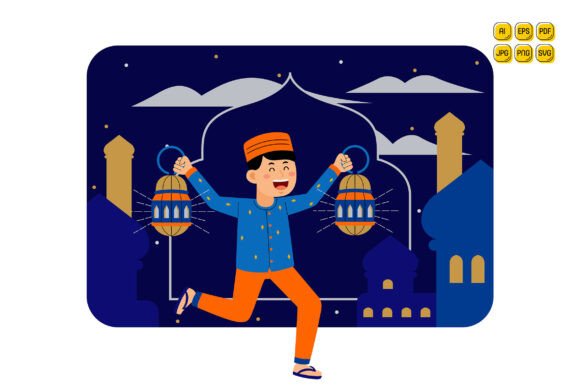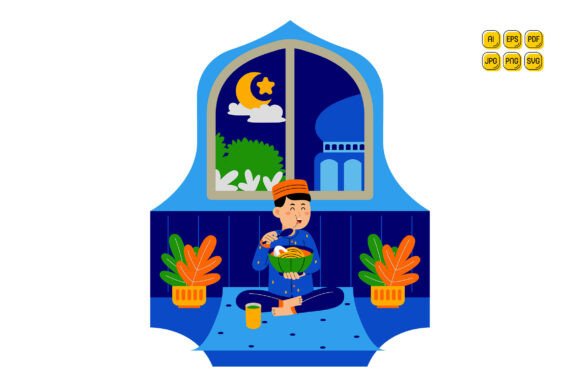
Man Eating Meal During Ramadan Night
The phrase Man Eating Meal During Ramadan Night refers to a culturally grounded, visually representational concept used in graphic design—specifically, a set of editable vector illustrations depicting a man seated at a table enjoying food after sunset during the holy month of Ramadan. These illustrations are not literal photographs or religious artifacts, but rather stylized, scalable design assets intended for professional use across branding, digital marketing, and educational contexts.
Such illustrations serve as visual shorthand for themes like community, gratitude, tradition, and spiritual renewal associated with Iftar—the evening meal that breaks the daily fast. They are commonly employed by organizations supporting interfaith outreach, Islamic education platforms, halal food brands, nonprofit campaigns, and multicultural event planners seeking respectful, inclusive imagery.
Why This Type of Illustration Matters for Designers and Communicators
Designers often need culturally resonant visuals that avoid stereotyping while remaining instantly recognizable. A well-crafted Man Eating Meal During Ramadan Night illustration offers clarity without oversimplification: it conveys time (night), action (eating), identity (a modestly dressed adult male), and context (Ramadan) through intentional composition—not text. Its flat design style ensures readability at small sizes, compatibility with modern UI frameworks, and ease of integration into responsive layouts.
Because these illustrations are delivered as vector files—including AI, EPS, SVG, and PDF formats—they retain crispness at any scale, from social media avatars to large-format banners. The inclusion of high-resolution JPG and transparent-background PNG files further extends usability across print, web, and presentation environments.
Key Benefits of Using These Vector Assets
- Customization flexibility: Every shape, color, and layer is editable in Adobe Illustrator, allowing users to adjust skin tones, clothing details, tableware, lighting, or background elements to match brand guidelines or regional preferences.
- Consistency across channels: With uniform styling across 100 unique variations, teams can maintain visual coherence in multi-platform campaigns—from email newsletters to Instagram carousels and landing pages.
- Cultural appropriateness: Designed with awareness of common visual sensitivities—such as avoiding exaggerated facial features or inappropriate dress—the illustrations support respectful representation without requiring custom art direction.
- Time efficiency: Ready-to-use vectors eliminate the need for commissioning original artwork or licensing restrictive stock images, accelerating production timelines for time-bound projects like Ramadan promotions.
Tradeoffs and Practical Considerations
While highly adaptable, these illustrations are not substitutes for nuanced storytelling. Their strength lies in symbolic communication—not narrative depth. Users should consider whether the context calls for emotional authenticity (e.g., documentary-style photography) versus functional clarity (e.g., an infographic icon). Overuse of generic figures may dilute brand distinctiveness if not paired with distinctive typography, layout, or supplementary content.
Additionally, although the set includes 100 variations, they share a consistent flat-design aesthetic and compositional framework. Those seeking photorealistic, hand-drawn, or animated interpretations will need complementary resources. Likewise, while color palettes are fully editable, users must ensure adjustments align with accessibility standards—particularly contrast ratios for text overlays or data visualization applications.
When This Resource Is a Strong Fit
A Man Eating Meal During Ramadan Night vector set is especially valuable when:
- You’re developing a multilingual website or app interface needing culturally relevant icons for seasonal features (e.g., Ramadan countdowns, Iftar reminders).
- Your team lacks in-house illustration capacity but requires consistent, on-brand visuals for a month-long campaign.
- You’re creating infographics about fasting practices, nutrition during Ramadan, or community engagement metrics—and need scalable, legible figures to represent participants.
- You're designing physical materials such as posters for mosque events, school assemblies, or public health initiatives where clarity and reproducibility matter more than artistic uniqueness.
When Alternatives May Be More Appropriate
Consider other solutions if:
- Your audience expects region-specific customs—for example, North African, South Asian, or Middle Eastern variations in attire, table settings, or food presentation—and the provided illustrations reflect only generalized conventions.
- You require dynamic or interactive elements—like hover effects, transitions, or layered animations—which static vector files cannot deliver without additional development work.
- Your project centers on personal testimony or lived experience; in those cases, authentic photography or commissioned portraits may convey greater credibility and empathy.
- You need legally defensible usage rights beyond standard commercial licenses—such as for broadcast media or merchandise—requiring review of the specific license terms accompanying the files.
Making an Informed Decision
Before acquiring or deploying this type of asset, assess your core objective: Is the goal to communicate speed, consistency, and cultural alignment—or to evoke individuality, realism, or emotional resonance? If scalability, editing control, and cross-platform compatibility are priorities, then a professionally crafted vector set like this delivers measurable utility. If differentiation, storytelling depth, or contextual specificity dominate your needs, pairing these illustrations with original photography, localized copy, or user-generated content may yield stronger outcomes.
Also evaluate technical readiness: Do team members have access to Adobe Illustrator or compatible software? Are workflows set up to manage layered vector files efficiently? Confirming these prerequisites helps avoid bottlenecks during implementation.
Finally, consider longevity. Because these files are resolution-independent and built using open vector standards (SVG, EPS), they remain usable across future tools and devices—even as display technologies evolve. That durability adds long-term value beyond immediate campaign needs.
In summary, a Man Eating Meal During Ramadan Night vector illustration set serves as a practical, reusable tool for communicators aiming to integrate culturally informed visuals into digital and print projects. Its value emerges not from novelty, but from reliability—offering clarity, adaptability, and respectful representation where those qualities directly support audience understanding and engagement.