Man Marking Ramadan on Calendar: A Flexible Visual Resource for Creative Professionals
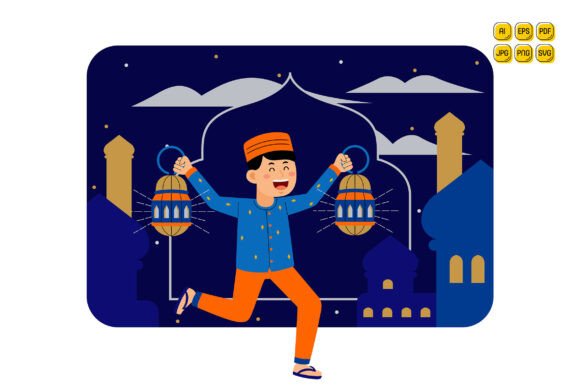
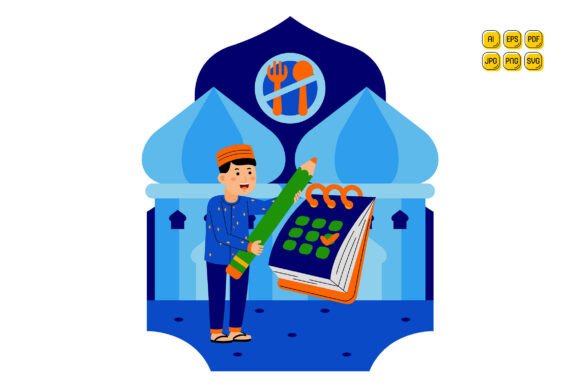
“Man Marking Ramadan on Calendar” refers to a curated set of vector-based illustrations depicting a person interacting with a calendar during the holy month of Ramadan — often shown marking dates, circling Laylat al-Qadr, or highlighting fasting periods. Unlike generic religious clipart or static stock photos, this collection is built for adaptability: each element is layered, labeled, and fully editable in industry-standard vector formats. It’s designed not as a finished design, but as a foundational toolkit — one that supports consistent visual storytelling across diverse communication needs.
What Sets This Collection Apart from Other Ramadan-Themed Graphics
Most Ramadan-related visuals fall into two broad categories: photorealistic assets (e.g., high-res lifestyle images of families breaking fast) and symbolic icons (e.g., crescent moons, lanterns, or mosque silhouettes). “Man Marking Ramadan on Calendar” occupies a distinct middle ground — it combines human-centered narrative with functional context. The figure isn’t abstracted or stylized beyond recognition; instead, they’re portrayed in a flat, inclusive, culturally neutral manner while engaging directly with a calendar interface. That specificity makes it especially useful when clarity, timing, and intentionality are central — such as in educational timelines, workplace inclusion calendars, community event planning, or digital reminders.
This distinction matters in practice. For example, a nonprofit producing a Ramadan awareness campaign for corporate HR teams may need visuals that convey both spiritual significance and logistical relevance — like marking Iftar times across time zones. A stock photo of a lantern might evoke mood, but it doesn’t communicate scheduling. In contrast, “Man Marking Ramadan on Calendar” supports that dual need without requiring custom illustration work.
Practical Flexibility Across Formats and Use Cases
The value of this collection lies less in its individual illustrations and more in how consistently they scale, recolor, and recombine. All 100 vector illustrations ship in AI, EPS, SVG, PDF, JPG, and PNG — including transparent-background PNGs sized at 5000 × 5000 pixels. That resolution ensures crisp output whether printed on a large banner or scaled down for an Instagram Story. More importantly, every shape — from the calendar grid lines to the figure’s clothing and even the marker pen — is individually selectable and editable in Adobe Illustrator.
This level of control enables real-world adaptation:
- Branding consistency: A university communications team can adjust all calendar illustrations to match their official color palette — changing only the accent color of the marker without altering line weights or proportions.
- Contextual reuse: An e-learning platform building a Ramadan wellness course could isolate just the hand and marker, then pair it with custom UI elements like progress bars or notification badges.
- Cross-platform optimization: SVG files allow responsive embedding on websites, while PNGs support social media posts where transparency or background blending is needed.
Unlike raster-only packs or locked templates, this collection assumes users will modify, layer, and reinterpret — not just drop in and go.
Comparing Approaches: When This Fits — and When It Doesn’t
“Man Marking Ramadan on Calendar” excels when your goal is clarity, customization, and narrative grounding. But it’s not universally optimal. Consider these tradeoffs:
Best-fit scenarios
It’s especially appropriate when you need to:
- Communicate time-bound observances — e.g., daily prayer windows, Taraweeh schedules, or countdowns to Eid — alongside human context.
- Maintain brand continuity across multiple touchpoints (email, landing pages, internal training decks) without commissioning bespoke art each time.
- Support multilingual or multicultural audiences with neutral, non-ethnic-specific figures — avoiding assumptions about dress, age, or regional tradition.
- Produce accessible materials: the clean flat design, high contrast options, and scalable vectors align well with WCAG-informed layout practices.
Limited-fit scenarios
It may be less suitable if you require:
- Highly specific cultural representation: The figures are intentionally generalized. If your project centers a particular regional tradition — say, Moroccan F’tour tables or Indonesian takjil markets — you’ll likely need supplemental photography or custom illustration.
- Animated or interactive elements: While SVGs can be animated via CSS or JavaScript, the base files are static. Teams needing micro-interactions (e.g., a calendar date lighting up on hover) would need to build those layers separately.
- Typography-integrated designs: These are illustration-only assets. There’s no pre-styled Arabic or bilingual text — which is intentional, as font licensing and script rendering vary widely across platforms and regions.
Evaluating Alternatives: Why Editable Vectors Matter
Many designers start by searching free icon sets or subscription-based illustration libraries. Those resources offer speed and breadth — but often at the cost of cohesion. A free “calendar” icon paired with a separate “Ramadan” icon rarely aligns in stroke weight, perspective, or tone. Even premium marketplaces may deliver assets as flattened PNGs or non-layered SVGs, limiting color adjustments or selective editing.
In contrast, “Man Marking Ramadan on Calendar” prioritizes interoperability over convenience. The decision to include AI and EPS files — not just SVG and PNG — signals support for professional workflows where precision matters: adjusting anchor points, exporting CMYK for print, or applying global swatches across dozens of files. That’s not overhead — it’s infrastructure for scalability.
That said, it’s worth noting that this collection doesn’t replace strategic design thinking. Choosing these illustrations won’t automatically improve message clarity — but it does remove technical friction from executing thoughtful, audience-aware visuals. A well-placed, correctly recolored “Man Marking Ramadan on Calendar” asset reinforces intent; a misused or poorly integrated one can dilute it.
Making the Call: Is This the Right Resource for Your Project?
Ask yourself three questions before selecting this collection:
- Do you need to communicate timing, ritual, or planning — not just symbolism? If your core message revolves around “when,” “how often,” or “what comes next,” this collection offers grounded visual language.
- Will your team edit, combine, or repurpose assets across multiple outputs? If yes, the layered vector structure saves hours versus rebuilding similar scenes from scratch.
- Is consistency across color, style, and scale a priority — not just one-off use? The uniform flat design and shared grid logic mean illustrations cohere naturally, even when used months apart.
If two or more answers are “yes,” this collection is likely a practical fit. If your needs center on emotional resonance over structure — or if you’re working under tight deadlines with no in-house design capacity — simpler, ready-to-use photo-based assets may serve better in the short term.
Ultimately, “Man Marking Ramadan on Calendar” reflects a shift toward modular, reusable design: not as a shortcut, but as a way to invest once in flexibility that pays off repeatedly — across campaigns, platforms, and years. It doesn’t promise perfection, but it does reduce repetition, increase fidelity, and support decisions rooted in both intention and practicality.