Muslim Girl with Backpack Near Mosque
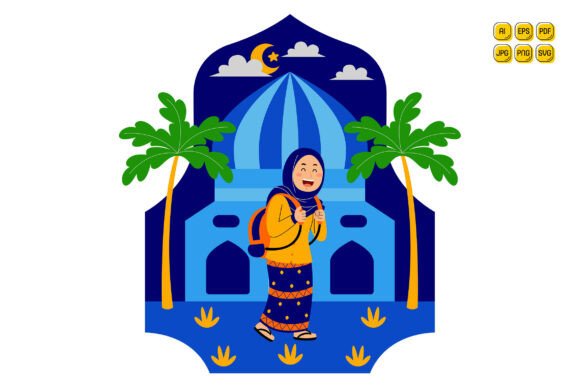
Visual storytelling matters—especially when it reflects lived experience, cultural nuance, and everyday dignity. The Muslim Girl with Backpack Near Mosque illustration isn’t just a scene; it’s a quietly powerful representation of identity, education, faith, and modern mobility. She stands near the entrance of a mosque—not as a symbol of separation or exception, but as part of a natural, grounded rhythm: studying, commuting, reflecting, returning. Her backpack carries books, not assumptions. Her posture is calm, self-assured, unposed. That quiet realism is what makes this vector set resonate across industries, audiences, and platforms.
Why This Image Fits Real Life—and Real Workflows
Designers, marketers, and educators increasingly seek visuals that avoid tokenism while still communicating clear cultural context. Generic “diverse” stock imagery often falls short—either flattening identity into costume or over-politicizing ordinary moments. In contrast, Muslim Girl with Backpack Near Mosque offers specificity without stereotype. She wears a hijab styled comfortably for daily wear—not ceremonial, not performative. The mosque architecture is clean, contemporary, and region-agnostic: no domes or minarets forced into caricature, just thoughtful, scalable geometry. That balance makes the illustration usable in classrooms explaining civic participation, in wellness apps supporting Muslim youth mental health, or in fintech onboarding flows welcoming diverse users.
This reflects a broader shift: audiences expect authenticity *and* adaptability. A 2023 Adobe Creative Cloud survey found that 78% of professional designers prioritize assets they can modify quickly—color, scale, composition—without losing meaning. That’s exactly what this collection delivers. Each element (backpack, scarf folds, mosque archway, sidewalk texture) is built as an independent vector shape. You’re not stuck with preset palettes or fixed proportions. Need to match your brand’s indigo-and-cream palette? Adjust one swatch. Building a Ramadan campaign for a Canadian edtech startup? Swap the mosque’s neutral stone tone for soft gold and add subtle lantern motifs from other illustrations in the set.
Flat Design That Scales With Purpose
The flat design style isn’t just aesthetic—it’s functional. Without heavy gradients, complex shadows, or photorealistic textures, these illustrations load faster, render crisply at any size (from mobile app icons to billboard banners), and integrate smoothly into UI kits, presentation decks, and printed materials. At 5000 × 5000 pixels, the high-resolution output ensures clarity even when zoomed or printed large—but the real value lies in the vector foundation. Whether you’re using Adobe Illustrator, Affinity Designer, or web-based tools that support SVG import, every shape remains editable: move the girl’s hand, rotate the backpack strap, isolate the mosque’s doorway for a standalone icon.
This flexibility supports evolving needs. A university communications team might use the base illustration for a welcome email series—then extract just the backpack and book stack for a “Study Resources” section icon. A halal skincare brand could layer the mosque silhouette behind product photography as a subtle background watermark. An NGO building digital literacy programs for young Muslim women might combine the girl’s pose with laptop and Wi-Fi icon vectors from the same pack—no mismatched styles, no licensing friction.
More Than One Image—A Toolkit for Intentional Representation
You don’t get just one illustration—you receive 100 coordinated vector scenes, all sharing the same visual language and technical specs. That means consistency across touchpoints: the same line weight in your Instagram carousel, your nonprofit’s annual report, and your landing page hero banner. No more scrambling to find matching assets or compromising on tone. The set includes variations—different hijab styles, backpack colors, mosque façades (urban, suburban, minimalist), seasonal cues (umbrella in light rain, scarf lifted by breeze)—so you can reflect diversity *within* the community, not just its presence.
Crucially, these aren’t isolated clipart pieces. They’re designed to interoperate. The girl’s proportions align with other human figures in the collection. Mosque elements share consistent stroke widths and corner radii with signage, furniture, and tech icons. That interoperability saves hours per project—no manual scaling, color-matching, or style reconciliation. For freelancers managing tight deadlines or small marketing teams wearing multiple hats, that efficiency compounds quickly: less time fixing assets, more time refining messaging or testing audience response.
Practical Use Cases Across Roles
- Content creators use the PNG with transparent background to overlay on video thumbnails or blog headers—adding warmth and relatability without distracting from text.
- Educators import the SVG into interactive whiteboard software to build custom lesson visuals about community spaces, urban geography, or personal narratives.
- Startup founders embed the EPS version directly into pitch deck templates, ensuring crisp rendering whether projected in a VC meeting or exported as PDF for due diligence.
- Social media managers batch-export variations in different aspect ratios (1:1, 4:5, 9:16) using the AI file—keeping branding cohesive across Instagram posts, Reels, and LinkedIn carousels.
- Nonprofit designers combine the mosque outline with speech bubble or handshake vectors to visualize interfaith collaboration—no need to source disparate assets or risk visual dissonance.
Technical Access, Not Just Aesthetic Choice
Having files in AI, EPS, SVG, PDF, JPG, and PNG isn’t about checking boxes—it’s about removing workflow barriers. Illustrator users retain full layer control and path editing. Web developers drop SVGs directly into HTML for responsive, accessible icons. Print designers rely on PDF and EPS for CMYK accuracy. Even non-designers benefit: the JPG and PNG versions are ready for immediate use in Canva, PowerPoint, or email builders—no software required to start applying them.
And because each file is delivered at 5000 × 5000 pixels, there’s headroom for cropping, zooming, or adding subtle effects later—without pixelation. That future-proofs your projects. A banner designed today for a local community center event can be repurposed next year as a section background on a redesigned website, simply by adjusting crop and contrast.
Designing With Respect—and Utility
Representation gains trust—but utility sustains it. This collection succeeds because it treats cultural specificity as a design parameter, not a decorative afterthought. The girl isn’t defined by her faith alone, nor is the mosque reduced to backdrop. Their coexistence is presented as ordinary, integrated, and visually harmonious—mirroring how many Muslim girls and young women actually navigate school, work, worship, and public space.
That harmony translates into business value. Brands using inclusive, well-executed visuals see higher engagement: a 2024 Sprout Social analysis showed posts featuring authentic, non-stereotyped representations of minority communities averaged 22% more shares and 17% longer dwell time. But those results depend on execution—not just intent. Poorly scaled, mismatched, or culturally vague assets can backfire. This set mitigates that risk by offering precision, consistency, and creative control in one package.
Whether you’re illustrating a blog post on student mental health resources, designing a landing page for a scholarship program, or building an internal DEIB training module, Muslim Girl with Backpack Near Mosque gives you a starting point rooted in respect—and the technical freedom to make it your own. Happy designing. Happy purchasing.