Startup Pitch Deck Keynote Template: Your Shortcut to Clear, Confident, Investor-Ready Presentations
If you’ve ever stared at a blank Keynote canvas before an investor meeting—wondering how to distill months of work into 12 slides that actually land—you’re not alone. A great idea means little without a great story. That’s where a thoughtfully built Startup Pitch Deck Keynote Template steps in—not as a shortcut around preparation, but as a strategic scaffold for clarity, credibility, and impact.
What It Really Is (and What It’s Not)
A Startup Pitch Deck Keynote Template isn’t just a set of pre-styled slides. It’s a narrative framework designed by people who’ve sat on both sides of the table: founders who pitched, and investors who’ve seen hundreds of decks. It anticipates what matters most—problem validation, traction signals, unit economics, team credibility—and structures your content to lead with evidence, not enthusiasm.
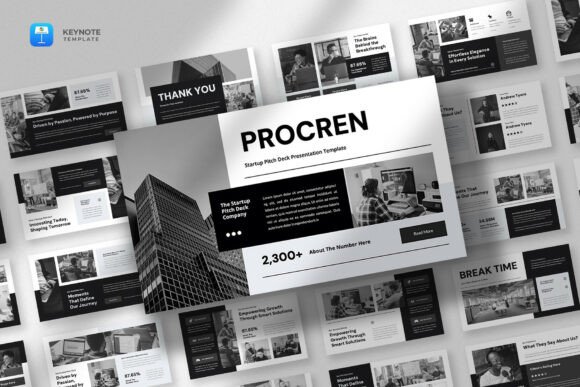
Take Procren, for example: a minimalist black Startup Pitch Deck Keynote Template built for founders who want boldness without clutter. Its clean lines, strong typography, and intentional white space aren’t about aesthetics alone—they’re cognitive aids. They guide attention, reduce cognitive load, and let your message breathe. You don’t edit *around* the design—you edit *into* it.
Where It Makes Real Difference—Not Just “Looks Nice”
Here’s where this template stops being decorative and starts delivering ROI:
- Seed-stage founders preparing for first VC meetings: You’re not just sharing vision—you’re proving viability. Procren’s data-driven slide layouts (think cohort charts, burn-rate visuals, or TAM/SAM/SOM breakdowns) help you present numbers with authority—even if your spreadsheet skills are still evolving.
- SaaS founders refining messaging for Series A: At this stage, investors care less about “what you do” and more about “why you’ll win.” The template’s problem-solution flow and competitive positioning slide force specificity—no vague “we’re disrupting X.” Instead: “Here’s the exact workflow friction we removed for 37 beta users—and here’s how it scaled to $42K MRR in 90 days.”
- Fintech or AI teams explaining complex tech to non-technical partners: Procren’s visual hierarchy and custom infographic placeholders let you simplify architecture diagrams, model training flows, or compliance frameworks—without dumbing them down. One fintech founder told us they replaced three dense technical slides with one timeline + icon-based process map—and landed their pilot deal two weeks later.
- E-commerce brands pitching to retailers or distributors: Shelf space is won with speed and clarity. The template’s product showcase and go-to-market slides help you spotlight differentiation fast: “Our cart recovery algorithm lifts repeat purchase rate by 22%—here’s the A/B test result, here’s the integration path, here’s the margin lift per SKU.”
Who Benefits—and How Their Needs Differ
A Startup Pitch Deck Keynote Template isn’t one-size-fits-all—but its flexibility is why it works across roles:
- Founders with zero design background: Drag-and-drop editing, consistent color palettes, and placeholder guidance mean you can swap logos, update stats, and adjust copy without second-guessing alignment or font pairing.
- Marketing leads building internal strategy decks: Need to align sales, product, and exec teams on Q3 priorities? Use the growth roadmap and milestone timeline slides—not for investors, but for clarity. One sustainability startup used Procren’s “Impact Metrics” layout to translate carbon-reduction goals into quarterly KPIs their ops team could execute against.
- Creative agencies pitching new clients: Swap out startup-specific slides for service-led storytelling: “Your challenge → Our approach → Past proof → Next steps.” The minimalist aesthetic builds trust faster than flashy animations ever could.
- Healthcare or edtech founders navigating regulatory nuance: The “Compliance & Validation” slide (often overlooked in generic templates) gives dedicated space for FDA clearances, HIPAA certifications, or curriculum approvals—signals that matter deeply in high-stakes industries.
Practical Considerations Before You Start
Before dropping your content into any Startup Pitch Deck Keynote Template, ask yourself:
- What’s the *one thing* this audience must remember? If it’s not obvious after reading your title slide, revisit your core message. Templates amplify focus—they don’t create it.
- Are your numbers credible—or just optimistic? Investors scan for consistency. If your market size says “$2.4B TAM,” your traction slide should show early signals that scale toward it—not just vanity metrics like “10K signups.” Procren’s data slides make inconsistencies harder to hide (in a good way).
- Do you have real customer voices? The “Customer Validation” slide isn’t for testimonials—it’s for quotes tied to outcomes (“Reduced our onboarding time from 14 days to 2 hours”). Template structure helps you source and place those moments meaningfully.
- Is your team slide telling a story—or just listing titles? Procren’s minimalist team layout pushes you to highlight *relevant* expertise, not just credentials. Example: “CTO: Built scalable backend for 5M-user edtech platform (acquired 2022)” lands differently than “15+ years in tech.”
Strengths That Go Beyond Style
What makes a Startup Pitch Deck Keynote Template like Procren genuinely useful—not just convenient—is how it handles real-world friction:
- No “design debt”: Every slide uses the same spacing system, font weights, and icon style—so your deck feels cohesive, even when edited by five different people.
- Adapts to context: Use the investor deck version for VCs, duplicate and trim slides for a 5-minute lightning pitch, or repurpose the problem/solution flow for a grant application.
- Supports iterative refinement: Because it’s built in Keynote—not locked PDFs or static images—you can test versions, get feedback, and revise without rebuilding from scratch.
A Note on Limitations—So You Don’t Waste Time
No template replaces deep thinking. If your value proposition is fuzzy, no amount of elegant typography will fix it. And while Procren excels at clarity, it assumes you’ll bring substance: real data, authentic customer insights, and a realistic path to revenue. Also, if your industry relies heavily on live demos or interactive prototypes, lean into embedding those *alongside* the slides—not instead of them. The template holds the frame; your execution fills it.
Bottom line? A Startup Pitch Deck Keynote Template doesn’t pitch for you. But it removes guesswork, cuts revision cycles, and gives your ideas the clean, confident container they deserve—so you spend less time wrestling with fonts, and more time refining what truly moves the needle.