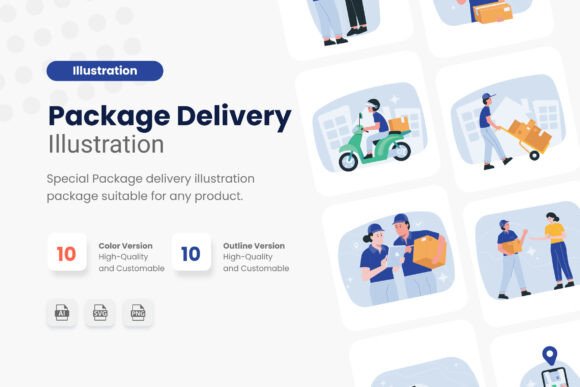
Package Delivery Illustration
If you’ve ever struggled to visually communicate the rhythm of modern logistics—whether it’s a courier handing off a parcel, a warehouse team scanning barcodes, or a customer tracking a shipment in real time—you know how much impact the right visual can have. Package Delivery Illustration isn’t just another clipart collection. It’s a thoughtfully crafted set of vector illustrations designed for people who need clarity, consistency, and creative control—not generic icons or overused stock imagery.
What You’re Actually Getting (and Why It Matters)
This set includes 10 fully editable vector illustrations: couriers on bikes and scooters, parcels stacked and labeled, delivery vans mid-route, sorting hubs in action, and even subtle human moments—like a recipient smiling at their doorstep. Each is built with clean lines, balanced negative space, and intentional color palettes that work equally well on dark mode apps or printed brochures.
Unlike raster-only assets, every illustration ships as an AI file (for deep editing in Adobe Illustrator), SVGs (for responsive web use), and high-res PNGs with transparent backgrounds. That means you’re not locked into one format or platform. A freelancer building a Shopify store can drop an SVG directly into a product page. An educator preparing a supply-chain lesson can paste a PNG into a Google Slides deck without worrying about pixelation. A small business owner launching a local delivery service can re-color a courier illustration to match their brand palette—in under two minutes.
E-commerce & Delivery Apps
Think about the last time you ordered something online. The “Order Confirmed” screen, the live map showing your package en route, the “Delivered!” notification—those moments rely on visuals that feel trustworthy and human. With Package Delivery Illustration, you avoid the coldness of generic icons. Instead, you show *how* delivery happens: a courier checking a smartphone, a parcel tagged with a QR code, a van pulling up beside a rowhouse. These aren’t decorative extras—they’re functional storytelling tools that reduce user hesitation and build confidence in your service.
Presentation & Training Materials
A logistics manager presenting quarterly KPIs to stakeholders doesn’t need flashy animations—she needs clear, scannable visuals that support her message. One slide might show three stages of fulfillment (pick → pack → ship) using matching illustrations from the set. Another could compare same-day vs. standard delivery timelines with side-by-side courier scenes. Because all illustrations share the same visual language—consistent line weight, perspective, and tone—the audience focuses on the data, not stylistic inconsistencies.
Branding & Marketing Campaigns
Small businesses launching a new local delivery offering often lack budget for custom illustration work. But using generic “truck + box” graphics makes them look like every other startup in the space. With Package Delivery Illustration, they can create cohesive social posts, email headers, and landing pages that feel distinct yet professional. A coffee roaster offering “roast-to-door in 48 hours” can pair a warm-toned courier illustration with real photos of their beans—blending authenticity and polish without hiring a designer.
Educational & Nonprofit Use
Teachers explaining global trade, community organizers mapping food distribution networks, or nonprofits designing infographics about last-mile delivery challenges—all benefit from visuals that are accurate *and* approachable. These illustrations avoid cartoonish exaggeration or corporate sterility. A student reading about supply chain resilience can see a realistic sorting facility layout—not a vague warehouse silhouette. That specificity supports comprehension and retention.
What to Consider Before You Download
First: check your intended use case against the licensing. This set is licensed for both personal and commercial projects—including client work—but files must be downloaded directly from Creative Fabrica. You’re free to share the product page link (great for teams or collaborators), but redistributing the actual files violates the license—and risks compatibility issues or outdated versions.
Second: think about scalability. If you’re designing for print (e.g., a 4’ x 6’ event banner), lean on the AI or SVG files—they’ll stay razor-sharp at any size. For fast web prototyping or social media posts, the PNGs save time—especially since they come with transparency already baked in.
Third: consider customization depth. Are you comfortable adjusting colors and layers in Illustrator? Great—you’ll get full mileage from the AI file. If you mostly use Canva or Figma, the SVGs will import cleanly, and many platforms let you recolor elements directly. Even if you only ever use the PNGs, the consistent style means they’ll hold together across multiple platforms without looking pieced together.
Who Benefits Most—and How
- Freelancers and agencies use these to speed up client deliverables—swapping out illustrations based on brand guidelines instead of waiting for custom art.
- Small e-commerce brands apply them to order status pages, FAQ sections, and “How It Works” modals—making complex logistics feel simple and human.
- Educators and trainers embed them in worksheets, LMS modules, or workshop handouts to reinforce concepts like transit time, packaging standards, or delivery exceptions.
- Bloggers and content creators illustrate posts about shipping sustainability, carrier comparisons, or unboxing trends—without relying on copyrighted photos or blurry screenshots.
- Hobbyists and makers use them in DIY packaging labels, craft fair signage, or printable tracking logs—adding polish to passion projects without design experience.
The strength of Package Delivery Illustration isn’t in its quantity—it’s in its intentionality. Every courier pose avoids awkward angles. Every parcel shows realistic labeling and tape placement. Every van has visible branding space—not because it’s “designed to be branded,” but because real-world delivery vehicles *are* branded. That attention to lived detail is what helps users connect faster, understand deeper, and act with more confidence.
Whether you’re explaining returns policy to first-time buyers, pitching a logistics SaaS tool to enterprise clients, or helping students visualize global trade routes—these illustrations don’t distract. They clarify. They support. They belong.