Woman Muslim Gives Money in Donation Box
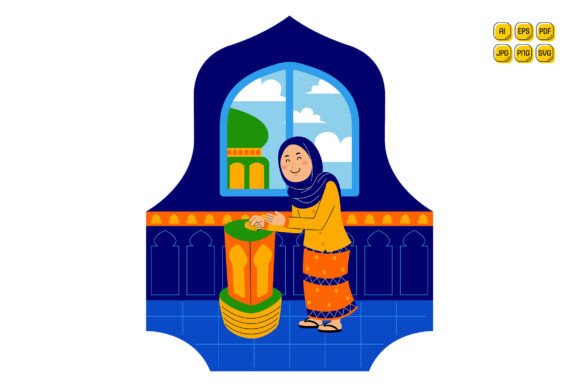
In today’s visually driven digital landscape, authentic, culturally resonant imagery isn’t just preferred—it’s essential. The illustration Woman Muslim Gives Money in Donation Box captures a quiet moment of intentionality: a woman in modest attire placing a donation into a box—hands visible, posture respectful, expression calm and purposeful. This isn’t symbolic staging; it reflects real-world values—compassion, community support, ethical giving, and spiritual alignment—that resonate across faith-based initiatives, nonprofit campaigns, educational resources, and socially conscious brands. Its relevance grows as audiences increasingly expect visual representation that honors diversity without stereotyping, communicates dignity without drama, and supports messaging with clarity—not clutter.
Why This Illustration Fits Modern Creative & Communication Needs
Designers, marketers, and content creators no longer rely on generic stock photos or overused clipart. They need assets that are both flexible and meaningful—images that can adapt to multiple platforms while retaining cultural accuracy and emotional authenticity. Woman Muslim Gives Money in Donation Box meets that need precisely. Its flat design style ensures clean scalability across devices—from mobile banners to large-format print—and its vector format means every element—clothing folds, box texture, hand gesture, background shape—can be individually recolored, resized, or repositioned. That level of control matters when aligning visuals with brand palettes, accessibility requirements (e.g., high-contrast variants), or multilingual campaign versions.
Consider how this flexibility translates in practice: A mosque’s Ramadan outreach team adjusts the illustration’s color scheme to match their annual campaign teal-and-gold theme. An edtech startup building a financial literacy module for young Muslim adults swaps the donation box for a digital wallet icon—keeping the same figure and gesture but updating context. A university’s interfaith center uses the same base asset across social media posts, presentation decks, and printed resource guides—each version customized for tone and platform, yet unmistakably part of one cohesive visual language.
Evolving Expectations Around Representation and Reusability
A decade ago, “diverse” illustrations often meant adding token figures to pre-existing templates—tacked-on rather than integrated. Today’s audience notices the difference. They recognize when representation is performative versus purposeful. What makes Woman Muslim Gives Money in Donation Box stand out is not just who is depicted, but *how* she’s depicted: no exaggerated features, no forced symbolism, no background noise. She’s centered, grounded, and engaged in an action tied to real human behavior—giving. That realism builds trust, especially among communities historically underrepresented—or misrepresented—in mainstream design libraries.
At the same time, workflow expectations have shifted. Freelancers juggle tight deadlines across five clients. Small business owners manage their own websites, email newsletters, and Instagram stories. Educators build lesson plans from scratch using free or low-cost tools. All of them benefit from assets that don’t require hours of editing to fit basic needs—no clipping masks needed, no pixelated upscaling, no licensing restrictions limiting usage across channels. With 100 vector illustrations included—each built with consistent styling and intentional spacing—the collection supports iterative, responsive design without sacrificing quality or coherence.
Practical Applications Across Industries
This isn’t a one-use image. Its strength lies in adaptability:
- Nonprofits & Faith-Based Orgs: Use it in donation appeals, annual reports, volunteer recruitment, or awareness campaigns around Zakat, Sadaqah, or community service.
- Educational Platforms: Integrate into modules about ethics, civic responsibility, comparative religion, or financial inclusion—paired with discussion prompts or data overlays.
- Small Businesses: Local halal cafes, ethical fashion labels, or wellness studios use it to signal shared values—on landing pages, “About Us” sections, or thank-you emails after purchases.
- Social Media Managers: Layer text, icons, or animated transitions onto the PNG version with transparent background for Instagram carousels, LinkedIn infographics, or TikTok explainers.
- Web Developers: Embed the SVG directly into HTML for crisp rendering at any screen size—and dynamically recolor elements via CSS variables for dark/light mode compatibility.
Because each file type serves a distinct role—AI and EPS for deep customization in Illustrator, SVG for web integration, JPG for fast-loading blog headers, PNG for layered composites—users aren’t forced to compromise between fidelity and function. And with all files sized at 5000 × 5000 pixels, there’s ample resolution headroom even for large-scale outdoor signage or high-DPI print projects.
Designing with Intention, Not Just Convenience
Easy-to-edit doesn’t mean shallow or generic. These illustrations were built with thoughtful hierarchy: clear visual weight on the central action (the act of giving), balanced negative space for text placement, and modular components (e.g., interchangeable boxes, hands, headscarves, backgrounds) that invite remixing—not just recoloring. You’re not limited to using the illustration as-is. Want to show collective giving? Duplicate the figure, adjust poses slightly, and group them around a shared box. Need a version for Eid al-Fitr? Swap in subtle decorative patterns or seasonal accents—while keeping line weight, proportion, and tone consistent.
This modularity reflects how modern design thinking has evolved: away from static “assets” and toward dynamic, reusable systems. It mirrors broader shifts in branding—where consistency isn’t enforced through rigid templates, but enabled through thoughtful component libraries. For professionals managing evolving brand guidelines or launching multi-phase campaigns, having a foundation like this saves time *and* strengthens message cohesion.
What You Receive—And Why Format Variety Matters
You’ll get more than just an image—you’ll receive a toolkit:
- 100 Vector Illustrations — Not variations of one scene, but a curated set covering related themes: different ages, settings (mosque, community center, home), donation types (cash, food, digital), and gestures (handing, placing, counting).
- Multiple File Formats — AI and EPS for full vector editing in Adobe Illustrator; SVG for responsive web use; PDF for universal viewing and print prep; JPG for quick uploads; PNG with transparent background for seamless layering.
- High-Resolution Output — Every file rendered at 5000 × 5000 pixels, ensuring sharpness whether viewed on a smartphone or printed at poster size.
- Flat Design Style — Clean lines, intentional spacing, and minimal detail—optimized for readability, fast loading, and cross-platform legibility.
No hidden layers, no locked elements, no rasterized effects. Just open, edit, export—and go. Whether you're preparing a grant application with branded visuals, designing a workshop handout, or building a Shopify banner that converts, this collection removes friction without compromising integrity.
Final Thought: Visual Language as Shared Value
Illustrations like Woman Muslim Gives Money in Donation Box do more than decorate—they communicate stance. They tell viewers: “This space acknowledges your identity. Your values are reflected here. Your actions matter.” In a time when attention is fragmented and trust is earned slowly, that kind of resonance isn’t incidental. It’s strategic. It’s human-centered. And it starts with choosing assets that are as thoughtful in their creation as they are versatile in their use.
Happy designing. Happy purchasing.