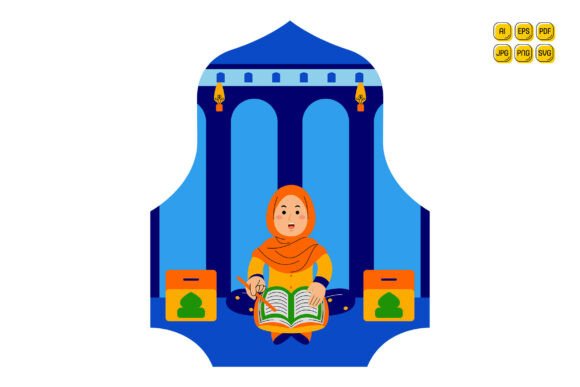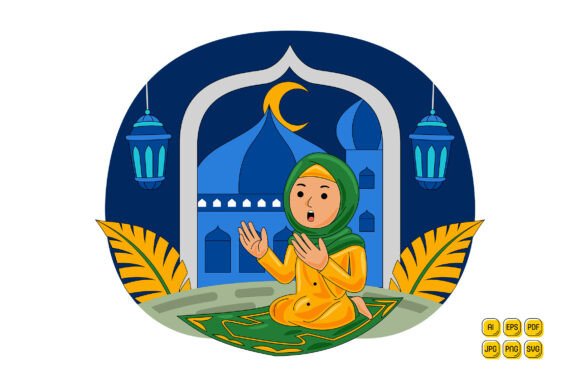
Woman Reading Quran on Prayer Mat
If you’ve ever scrolled through design resources looking for a respectful, culturally grounded visual that balances spirituality with modern usability—you know how rare it is to find something both meaningful and versatile. Woman Reading Quran on Prayer Mat isn’t just another stock illustration. It’s a thoughtfully crafted vector asset designed for real-world use—whether you’re building a wellness app, launching an Islamic education platform, designing Ramadan social media campaigns, or creating inclusive classroom materials.
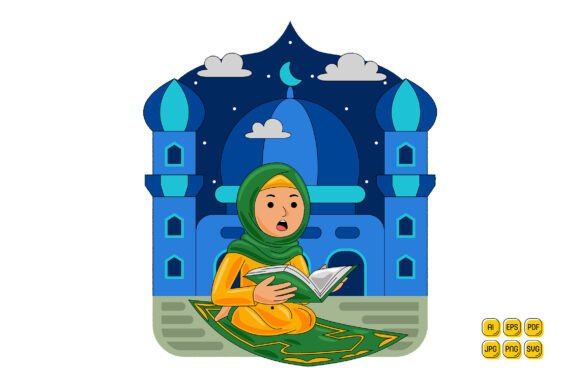
This illustration centers a calm, dignified woman seated on a traditional prayer mat, gently holding an open Quran. Her posture reflects reverence—not performance. The flat design style keeps it clean and scalable, while the intentional simplicity ensures it works across contexts: from a subtle watermark on a podcast cover to a bold banner for a mosque’s annual literacy drive.
Where This Illustration Fits Naturally—Not Just “Fits In”
Think about the last time you needed a visual that communicated quiet devotion without cliché, or spiritual focus without overstatement. Maybe you were drafting a blog post about mindful recitation (tajweed) and wanted a header image that felt warm and grounded—not staged or overly ornate. Or perhaps you run a small publishing house releasing bilingual children’s books on prayer, and you needed consistent, editable characters across 12 titles. That’s where Woman Reading Quran on Prayer Mat becomes more than decoration—it becomes part of your workflow’s rhythm.
It’s used by educators embedding visuals into digital worksheets for teen Quran study circles. By content creators preparing Instagram carousels on daily reflection practices. By freelancers building landing pages for halal-certified wellness coaching services. And yes—even by interior designers sourcing subtle, faith-aligned art prints for modest living spaces.
Why Customizability Matters More Than You Think
You don’t need to be a designer to benefit from this set—but if you *are*, you’ll appreciate how deeply editable it is. Every element—the folds in the prayer mat, the curve of the Quran’s spine, the fabric texture on her hijab—is built as a separate vector shape. That means you can:
- Swap the background color to match your brand palette—no clipping masks or guesswork.
- Adjust the woman’s hijab color to reflect regional styles (e.g., soft sage for a nature-based mindfulness brand, deep indigo for a scholarly publication).
- Isolate the Quran and add Arabic calligraphy overlays—or remove it entirely to use just the mat as a minimalist pattern base.
- Combine the figure with other assets from your library: pair her with a sunrise silhouette for a “new beginnings” theme, or layer her beneath a floating quote in Naskh font for a printable dua card.
This level of control saves hours—not just in editing, but in maintaining visual consistency across platforms. A single AI file lets you export crisp PNGs for email headers, SVGs for responsive website icons, and high-res JPGs for print brochures—all from one source.
Real Use Cases—No Assumptions, Just Scenarios
A homeschooling parent downloads the set to build weekly lesson slides. She changes the mat’s green tone to match her curriculum’s seasonal color scheme (earth tones in autumn, cool blues in winter), then adds a speech bubble with a short tafsir excerpt—keeping focus on comprehension, not aesthetics.
A Muslim-owned tea brand uses the illustration as a subtle watermark behind product photography. They tint the hijab fabric to echo their signature saffron blend packaging—creating cohesion without literalism.
An edtech startup developing an app for Quran memorization integrates the vector into onboarding screens. When users select “female voice + visual aid,” the illustration appears with animated page-turning effects—built directly from the layered SVG structure.
A nonprofit organizing community Iftar events pulls the EPS file into Canva, resizes it for 3x5 ft banners, and overlays local mosque names and meal times—all while preserving sharp edges at full scale.
What to Consider Before Using It
Respect starts before design—and that means thinking intentionally about context. Ask yourself:
- Who is the viewer? A devotional image used in a mental health resource for teens should feel accessible—not distant or overly formal. Adjust expression or setting accordingly (e.g., soften shadows, add gentle light).
- What’s the message? If promoting interfaith dialogue, consider pairing the illustration with inclusive language and complementary symbols—not as a replacement, but as one voice in a broader chorus.
- Is cultural nuance reflected? While the base illustration is intentionally neutral in attire and setting, customization helps align it with your audience’s lived experience—whether that’s West African kente-inspired mat patterns or South Asian floral borders added via the editable layers.
You also don’t need Illustrator to use it. The included PDF and SVG files open in free tools like Inkscape or Figma. The 5000×5000 px resolution means even large-format prints stay crisp—and the transparent PNG option makes drop-shadows, gradients, or layered web layouts effortless.
More Than 100 Illustrations—More Than Just Variety
The collection includes 100 variations—not random tweaks, but purpose-built adaptations. Some show different angles (side view for storytelling sequences, top-down for infographic layouts). Others feature seasonal elements (a soft snowfall overlay, a date palm branch in the corner for Ramadan). Several isolate key components: just the hands holding the Quran, just the mat with geometric borders, just the silhouette against dawn light. Each variation solves a specific need—like fitting vertical Instagram Stories or balancing text-heavy landing pages.
And because all files are delivered in native Illustrator (.ai), EPS, SVG, PDF, JPG, and PNG formats, there’s no vendor lock-in. No need to pay for conversions or wrestle with rasterized messes. What you download is what you deploy—fast, cleanly, and confidently.
At its core, Woman Reading Quran on Prayer Mat supports intentionality—not just in design, but in communication. It meets people where they are: whether that’s a student reviewing surahs before exams, a marketer crafting empathetic Ramadan ads, or a grandmother printing a keepsake for her granddaughter’s first Quran journal. It doesn’t shout. It settles in—calm, clear, and quietly powerful.